Labels

zondag 4 december 2016

Monstera Deliciosa - Gatenplant

Monstera Deliciosa - Gatenplant


Afkomst - De Monstera komt van oorsprong uit de tropische regenwouden van Midden- en Zuid-Amerika. In die omgeving is het een half klimmende plant van enkele meters hoog met blad dat een doorsnede van 1 meter kan bereiken. De vlezige luchtwortels zetten zich vast aan boomstammen, rotsen of gewoon in de grond.

Verzorging - De Monstera Deliciosa is een sterke plant die niet veel verzorging nodig heeft. Regelmatig watergeven en 1 maal per 2 weken plantenmest toedienen is voldoende voor jarenlang plezier. De plant kan zowel op een donkere als een lichte plaats staan. Hoe meer licht hoe sneller de plant groeit. Direct zonlicht is niet goed voor de plant. De bladeren af en toe nat afnemen of afspuiten met lauw water. De lange luchtwortels mag u afknippen of terugleiden in de potgrond waarna ze als grondwortel verder groeien.

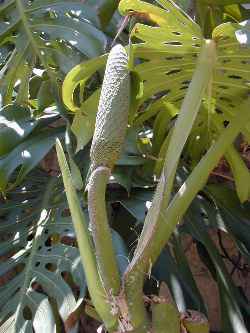
Bloei - Soms ontwikkelt de plant een zuiver witte bloem die naar ananas ruikt en waaraan paarse besjes ontstaan.


Vermeerderen - U kunt de plant vermeerderen door een stuk steel met blad af te snijden, liefst met een luchtwortel, en deze in vochtige, luchtige potgrond te plaatsen. Vermeerderen kan ook door middel van zaad.

Verse Lucht - Monstera is een plant die meehelpt de lucht in uw woning of kantoor te zuiveren door CO2 op te nemen en zuurstof af te geven.


Monstera als kuipplant - Naast het gebruik van de Monstera als potplant kan hij ook in de periode mei tot september als kuipplant buiten in de tuin ,serre of tuinkamer geplaatst worden. Wel dient de Monstera geplaatst te worden op een windvrije en schaduwrijke plek.
Na de zomerperiode kunt u de Monstera dan weer als kamerplant binnen plaatsen


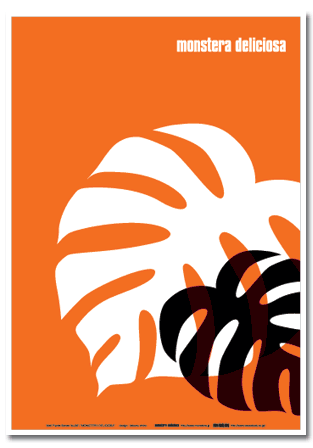
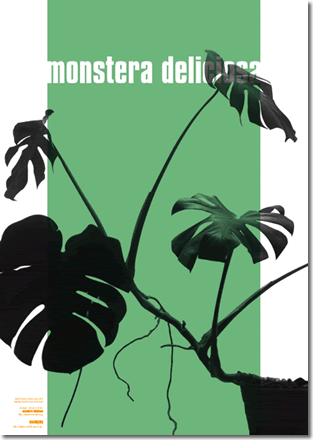
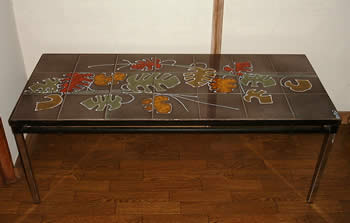
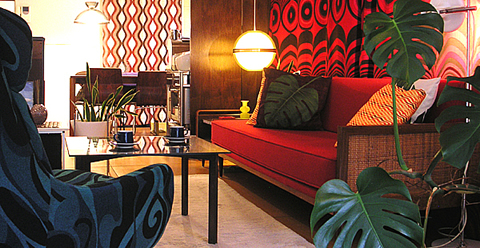
Monstera in kunst en design - De vorm van het Monsterablad is ook in de wereld van kunst en design een bron van inspiratie. In het bijzonder in landen in en rond de Stille Oceaan zijn daar voorbeelden van te vinden. Hieronder enkele voorbeelden:

Japan - In Japan is ontwerper Tetsuro oh!no geinspireerd door de Monsteravorm en hij probeert deze middels enkel succesvolle websites in japan te promoten.
Nieuwsgierig ? Bekijk dan zijn website: www.monstera.jp
Tetsuro oh!no ontwerpt posters en illustraties met Monstera erin verwerkt.
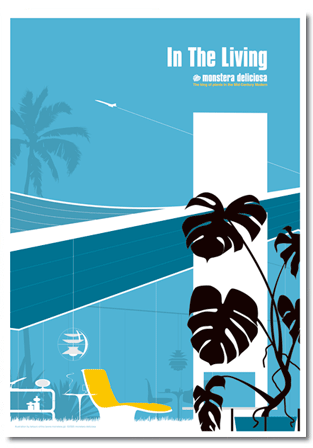
       

Ook combineert hij de Monstera met mid-century modern ontwerpen op gebied van meubelen en interieur.
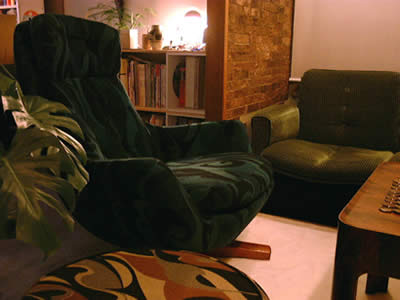


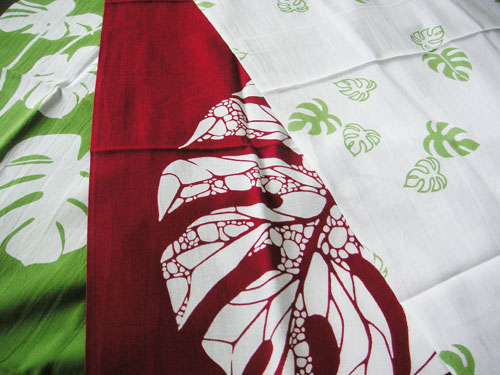
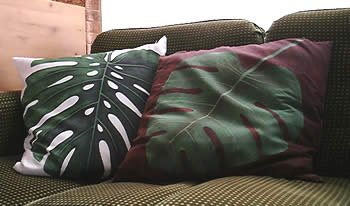
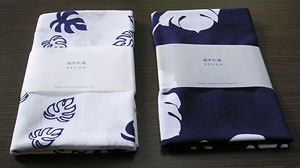
Op gebied van textiel ziet u hier de Tenugui (Japanse handdoek) en Monstera kussens


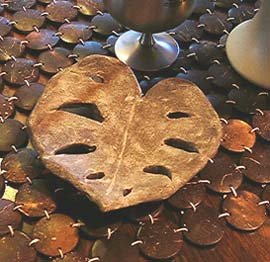
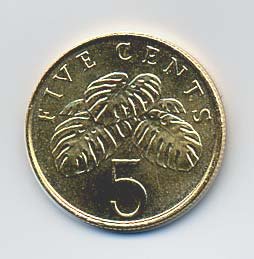
Singapore - In Singapore is er zelfs een 5 cent-munt met daarop de afbeelding van een Monstera.


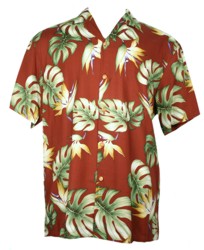
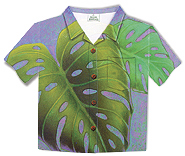
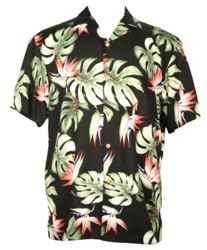
Hawai - Op Hawai Aloha-shirts wordt ook veelvuldig gebruik gemaakt van het Monstera motief.

               

Monstera


Monstera

From Wikipedia, the free encyclopedia
Monstera
Starr 080731-9572 Monstera deliciosa.jpg
Monstera deliciosa
Scientific classification
Kingdom: Plantae
(unranked): Angiosperms
(unranked): Monocots
Order: Alismatales
Family: Araceae
Subfamily: Monsteroideae
Tribe: Monstereae
Genus: Monstera
Adans.[1]
Synonyms[2]
  • Tornelia Gutierrez ex Schott
  • Serangium Wood ex Salisb.
Monstera is a genus of about 50 species of flowering plants in the arum family, Araceae, native to tropical regions of the Americas. The genus is named from the Latin word for "monstrous" or "abnormal", and refers to the unusual leaves with natural holes that members of the genus have.[3]
They are herbs or evergreen vines, growing to heights of 20 metres (66 ft) in trees, climbing by means of aerial roots which act as hooks over branches; these roots will also grow into the soil to help support the plant. The leaves are alternate, leathery, dark green, very large, from 25–90 centimetres (9.8–35.4 in) long (up to 130 centimetres (51 in) long in M. dubia) and 15–75 centimetres (5.9–29.5 in) broad, often with holes in the leaf blade. The flowers are borne on a specialised inflorescence called a spadix, 5–45 centimetres (2.0–17.7 in) long; the fruit is a cluster of white berries, edible in some species.
They are commonly grown indoors as houseplants. The best-known representative of the genus, Monstera deliciosa, is also cultivated for its edible fruit which tastes like a combination of banana and pineapple.
The variety in the picture is a trailer, which has heart shaped perforated leaves; the climber type has rectangular shaped perforated leaves.

zondag 30 oktober 2016

Doryopteris Cordata


Doryopteris Cordata  Antenne Varen

https://www.bakker.com/en-ie/p/antenna-fern-M47593


Antenna Fern product photo

An Unusual Fern

A unique fern that first forms a low growing rosette of foliage then later new leaves grow on a tall, upright stem. This gives the new leaf the look of an antenna (hence the common name for it). This easily grown fern likes a light spot out of direct sunlight. Suitable for use in a terrarium. Originating in the rainforests of South America, this is a really decorative, easily grown fern. In nice warm and humid conditions, the antenna fern (Doryopteris cordata) will creep out of the confines of its pot on a rhizome.

Myrmecodia Adventure


Myrmecodia Adventure


source: http://www.vdeplant.nl/collection/myrmecodia-adventure/

Ik ben een echte avonturier. Ik ben de Myrmecodia Adventure. Deze naam heb ik gekregen omdat ik een echte avonturier ben. Van oorsprong heb een bijzondere groeiwijze, ik ben namelijk een epifyt, wat groeiend in bomen betekent. Epifyten zijn organismen die op levende planten kunnen groeien zonder voedsel aan de plant te onttrekken. Op jouw ontdekkingsreis in tropisch Azie kan je mij tegen komen in de mangroves.

Ik ben een langzaam groeiende plant, en vorm een knol aan de basis van mijn stengel. Wist je dat er in mijn knolvormige stam zich holle kamers bevinden? In de tropen gebruiken mieren deze als schuilplaats. De mieren patrouilleren als bewakers door mijn kamers en verwijderen vreemde bladeters terwijl hun uitwerpselen zorgen voor extra voedingsstoffen die door mij worden geabsorbeerd. In de huiskamer geven we de planten gewoon voeding zodat ze net zo goed kunnen groeien. Ik verander steeds, in mijn bloeiperiode vormen zich kleine witte bloemetjes welke uitgroeien tot doorzichtige / witte langwerpige besjes. Kies een standplaats met veel indirect licht, maar liever niet in de volle zon. Geef regelmatig water maar houd de grond licht vochtig en niet te nat.
Ant plant - Adventure

zondag 23 oktober 2016

Horticultural Therapy


SOURCE: http://twigterrariums.com/pages/horticulturaltherapy 

Horticultural therapy (HT) is a time-proven practice, and the therapeutic benefits of garden environments have been documented since ancient times. In the 19th century, Dr. Benjamin Rush, a signer of the Declaration of Independence and recognized as the "Father of American Psychiatry," was first to document the positive effect working in the garden had on individuals with mental illness.


Today, HT is accepted as a beneficial and effective therapeutic modality and it is widely used within a broad range of rehabilitative, vocational, and community settings.In the 1940s and 1950s, rehabilitative care of hospitalized war veterans significantly expanded acceptance of the practice. No longer limited to treating mental illness, HT practice gained in credibility and was embraced for a much wider range of diagnoses and therapeutic options.

HT techniques are employed to assist participants to learn new skills or regain those that are lost. HT helps improve memory, cognitive abilities, task initiation, language skills, and socialization. 

***************** 

Twig Terrariums focuses on the sensory aspects of HT such as touch/texture, sound, smell, as well as the design aspect, in order to encourage a relaxing, creative and safe environment. A cognitive therapeutic approach is used with special focus on gently centering the participant in the present task. Each attendee will receive individual attention, their own container, and all the ingredients to create their own little green world.

The workshop instructs how to make a terrarium, how terrariums were invented, the different terrariums out there, information on the plants we use and why, the basics of miniscaping (miniature design), and how to care for it in the future. Moss terrariums are especially forgiving because they require very little care – simply keep in a shady spot and mist every two to four weeks and the benefits of a terrarium workshop can last for weeks!

Twig Terrariums is committed to exploring the therapeutic aspect of terrarium-making, gardening, urban farming, container gardening, as well as working in the floral arts and gardening industry. For more information please email HortTherapy@twigterrariums.com. 

zondag 7 augustus 2016

wardian case


Wardian Case

https://en.wikipedia.org/wiki/Wardian_case

The Wardian case was an early type of sealed protective container for plants, an early version of the terrarium. It found great use in the 19th century in protecting foreign plants imported to Europe from overseas, the great majority of which had previously died from exposure during long sea journeys, frustrating the many scientific and amateur botanists of the time. The Wardian case was the direct forerunner of the modern terrarium, Vivarium (and the inspiration for the glass aquarium), and was invented by Dr. Nathaniel Bagshaw Ward (1791–1868), of London, in about 1829 after an accidental discovery inspired him.[1] He published a book titled On the Growth of Plants in Closely Glazed Cases in 1842.[2]


source:
http://www.stormthecastle.com/terrarium/wardian-cases.htm

Wardian Cases


Terrariums are generally credited with being invented by a man named Nathaniel Bagshaw Ward. He invented them during the Victorian era and created a style of glass case with a metal frame that was very popular during the era. These terrariums were called "Wardian Cases" after Ward. You can learn more about him and the history of the terrarium on my page here "The History of the Terrarium" The picture shown here is a Victorian Wardian Case. I have on this page two sizes of terrariums Table Top and Floor Model.
The traditional style of wardian case is made much like a stained glass window with metal around the edges holding sheets of glass together. But in the wardian case the glass is clear to allow sunlight to pass through. 


The History of Terrariums

The bringing of the art of the terrarium is generally credited with a man called Nathaniel Bagshaw Ward. This came about with the publishing of his book called "On the Growth of Plants in Closely Glazed Cases" which he published in 1842. The second edition of this book was published in 1852 and is readily available in the public domain. Google books has it available here

In the preface to his first edition he cites an earlier reference where he wrote a letter that was published in the "Companion to the Botanical Magazine" which was published in the May 1836 issue. He also gives credit to an author named Mr. Ellis who published an article about growing plants in closed cases in an article in "Gardeners Magazine" in September of 1839. The publication of the "On the Growth of Plants in Closely Glazed Cases" is considered to be the first substantial work that outlines the theory and keeping of terrariums.
The story of how he first discovered the terrarium is rather interesting and Ward tells it in his book.
A Wardian Case or TerrariumHe had the desire to watch an insect chrysalis transform into an insect so he placed it, along with some mould in a capped wide-mouthed glass bottle. He observed this bottle on a regular basis and noted how, because of the sun, moisture would be drawn to the top of the bottle during the day then circulate back down to the mould and soil in the evening.
But his big surprise came when quite unexpectedly a seedling fern and a sprout of grass bloomed inside the bottle. He was very suprised by this because he had been unsuccessfully trying to grow these very things in his garden. He had surmised that pollution from local factories had been hostile to the plants and was killing them. This made him believe that the plants were doing well in his little bottle because they were sealed off from outside influences and protected from contaminants. He placed this bottle outside the window of his study and the plants inside continued to thrive for four years with no watering or outside intervention at all! From this he devised further experiments and thus his pursuit, and the science of the terrariums, was born. For a very long time these small glass enclosures were named Wardian Cases after him and even though the term is still in use today it is generally not well known and we just call them terrariums.

Terrariums Grew In Popularity
During the Victorian Era and predominantly in England terrariums or "Wardian Cases" became very popular and many people kept them in their homes. But over the course of decades the practice fell in decline and in todays world they have made a bit of a comeback but have never reached the every day popularity that they had achieved in the days of Ward.
The Style of the Wardian Case still remains today
victorian style modern terrariumThis style of case which was created by Ward and was very popular in Victorian England was a series of sheets of glass framed together with metal. The picture at the top of this page gives you a good idea of this. And this Victorian style case has made quite a comeback over the past decade or so. Several companies now manufacture and sell them.


I have plenty of tutorials on this website that will show you exactly how to make all kinds of terrariums from bottle, to plastic bottle to dish and even big ones in an aquarium! Have some fun with terrariums. If you are particularly interested in Wardian Cases I have a nice selection of them you can buy here

Fern in a bottle - the accidental terrarium
Terrariums got their start when a Dr. Ward discovered a fern growing inside a bottle over 150 years ago. I just received an email with pics from someone who found a fern in a bottle. Its a wonderful re occurrence. Read about the fern in the bottle and see more pics of this one: The Fern in the bottle and the Wardian Case


materials for making a terrarium
The fool proof Guide to making a beautiful terrarium in 1 hour