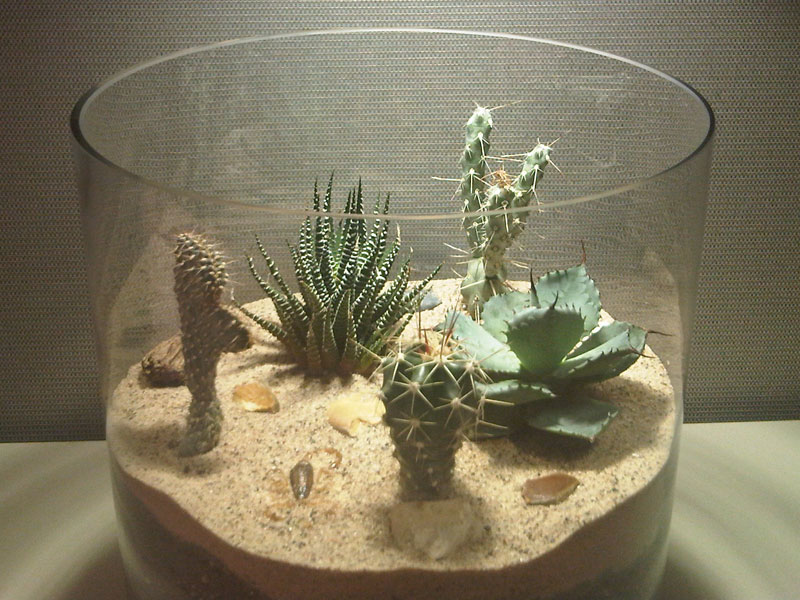
How-To-NOT Build a Cactus Terrarium
The world is full of free advice. Some of it is good and some
not-so-good. Building a cactus terrarium falls in to
the later category. While the immediate results of a such a terrarium
can be very attractive, the future of the project
is doomed from the start. The purpose of this article is to detail
some of the specific problems that must be addressed for the
welfare of the plants. Of course, if the problems are dealt with
properly, the project will no longer qualify as a terrarium.

Initially, a Cactus and Succulent Terrarium is Very Attractive! Photo: David Gonzales
Before we get into all the reasons NOT to make a cactus terrarium,
lets first explore why they are being made in the first place. To start,
a terrarium is intended to be
something like a mini-ecosystem in a glass box. We like them because
they enable us to see living things in a more natural or sometimes even
in a fantasy setting - all from
the comforts of our living room or office. Those of us who love desert
ecosystems are easily enticed by the thought of having a mini version
of some sand-covered landscape,
punctuated by spiny, water-storing plants and accented with reptiles
or large invertebrates like scorpions! (see image above) As with real
deserts, there is a beauty within the harshness
that fascinates and interests us.
Some people my hit the web and search out instructions for making
their own desert terrarium, while others may happen across it while
watching their favorite
home decorating show. In fact, this article was prompted by a recent
Martha Stewart presentation on creating a succulent terrarium. While I
didn't see this show, I
learned about it after receiving several e-mails from viewers who did
see this show and still had some questions. Knowing that this would be
an on-going topic, I
decided to put this article together in response to these other
sources and hopefully prevent some people from going through a lot of
trouble for nothing.
We'll soon get into specifics, but I have one last introductory point
or what could actually be considered a disclaimer. If you only have a
temporary use planned for your
desert terrarium - such as a wedding centerpiece or simply
entertaining guests for a week, this article doesn't apply. Many cactus
and other succulent plants
would look fine after being left in a cardboard box for a whole month
in the back of some dark closet. This is because these plants will often
wait out poor conditions
and either grow very slowly or not at all with no ill effects. This
sets them apart from other plants, yet even though they can survive this
way, a bad environment will eventually win and
the plants will die. The counter-advice that I am giving here is aimed
at people who want their cactus plants to grow, flourish, and even
flower - not simply survive for a few
months and then die an early death.
Finally! On to the specifics (in no particular order):
Airflow: Succulent plants, especially cacti, appreciate good
air circulation. They will not get this down in a glass jar even if
there is no lid. Fish bowls that
have a narrow opening are even worse and rectangular aquariums are no
better. In addition to poor air circulation, the glass sides increase
humidity which is also
detrimental to most cacti.
Water: There is a widespread myth that cactus and succulents
don’t like having much water. In truth, they actually appreciate lots of
water. As long as it is warm enough and they
are getting plenty of light, they will benefit from a good soaking. In
a terrarium without drain holes it is impossible to water these plants
properly. This is because the
plants like a good drink, but they do not like wet feet. The soil
should be allowed to dry between watering and there should not be any
"sitting" water at the
bottom of the pot. Overwatering is one of the fastest ways to kill a
cactus and as a result, people with these terrariums will suggest
watering in very small amounts at
a time. While a seemingly reasonable solution, the result will be
unhappy plants. In habitat, these plants form extensive root systems to
take in large amounts of
water all at once with a dry period between rains. In the Martha
Stewart example, the advice is to allow no more than 1 inch of water to
sit in the bottom. In a container
without drainage holes and a layer of potting soil and sand on top, it
would take months for this 1 inch of water to dry up. During that time,
the plants would be getting
little or no water at all.
Soil Layers: Most, if not all of the cactus terrarium tutorials
advocate a layered soil. This, no doubt, stems from a general
understanding that cacti do
not like growing in a swamp. With a lack of drain holes at the bottom,
any water that is put into the container stays in the container until
the plant uses
it or it evaporates. This is true with or without layered soil. Now
water will soak up through any soil it is in contact with, but it
doesn't soak
up through a layer of gravel. This makes adding a layer of gravel or
small rocks seem like a simple solution to the problem. In reality, this
theory doesn't
hold true. As mentioned above, these plants put out extensive root
systems. The roots of the plants are not going to stay neatly
confined in the middle layer of potting soil. They will continue
growing down into the rocky layer. As a result the roots in the organic
part of the mix will be too wet
and the other too dry or they will both be too wet or both be too dry.
You can’t have the entire root system with the right amount of water
when the roots
extend into layers that hold different amounts of water for different
lengths of time.

A side view illustrating the soil layers. - Photo: David Gonzales
Light and heat: Many cacti are sun lovers and many will grow
very happily in full sun all day in Phoenix, AZ and even ask for more
sun! While you might select some
cacti that can be grown with less light than that, you will still need
to provide a good deal of strong sunlight or artificial light. To do
this, you’ve got put the
container in sunlight at least part of the day and at least part of
the year. However, if you do that, the high glass sides of the terrarium
will act like a solar oven and it
will be far too hot without enough airflow and you’ll literally cook
the plants. While artificial lights may not heat the interior as much as
direct sunlight, it is
extremely challenging to provide enough artificial light to properly
grow cactus plants.
Container size: If a plant is alive, it will want to grow,
meaning it will get bigger. While there are some cacti and succulents
that remain relatively small,
many of them get quite large. In addition to growing up and out, the
root systems will quickly fill the container. For a given terrarium,
either the plants will have to
stay small or the container will need to be impracticably large to
contain them. Seldom is a terrarium chosen large enough to house plants
that are happily growing. Of course,
the other cultivation issues will need to be addressed in order to
have healthy growing plants. So even if all other conditions are met,
the terrarium will still be only
temporary before the plants need to be moved to a larger container.
Plant Compatibility: With most terrariums and also with "dish
gardens" plants are chosen with no consideration for potential growth.
Aside from the
crowding issues that accompany a container that is too small, plants
also grow at different rates. Some plants may be in need of a larger
container within a year while others
might never outgrow the initial container size. An even bigger problem
with confining multiple plants to one small container is that different
plants require
different amounts of light and water at different times. If you have a
thirsty plant in the same container as a plant that has too much water,
it is a lose-lose situation. The
more plants you have in one container, the more complicated this gets.
The same is true of light; not all plants want the same amount of sun
and/or shade. Even with multiple
plants of the same species the needs can vary plant by plant. In any
case, having a bunch of the same plants in one pot doesn't make for a
very interesting terrarium.
In conclusion, the hardy drought-resistant nature of these plants
means that they will make an attractive mini-desert terrarium that can
last for several
months. Never-the-less they will slowly begin to die off over the
course of a year or maybe even two depending on the plants and
conditions. While that may
seem like a long time, most cactus will grow for many decades when
properly cared for and produce some of the most outstanding flowers of
any type of plant. You
can see many examples of properly cultivated plants here on
CactiGuide.com as well as get information on the best way to care for
your plants. I recommend the
Growing Page for starters. Finally, even if you may not have a quaint mini-desert in a glass box, growing cacti properly
can prove to be a very rewarding horticultural hobby.
Author: Daiv Freeman |